
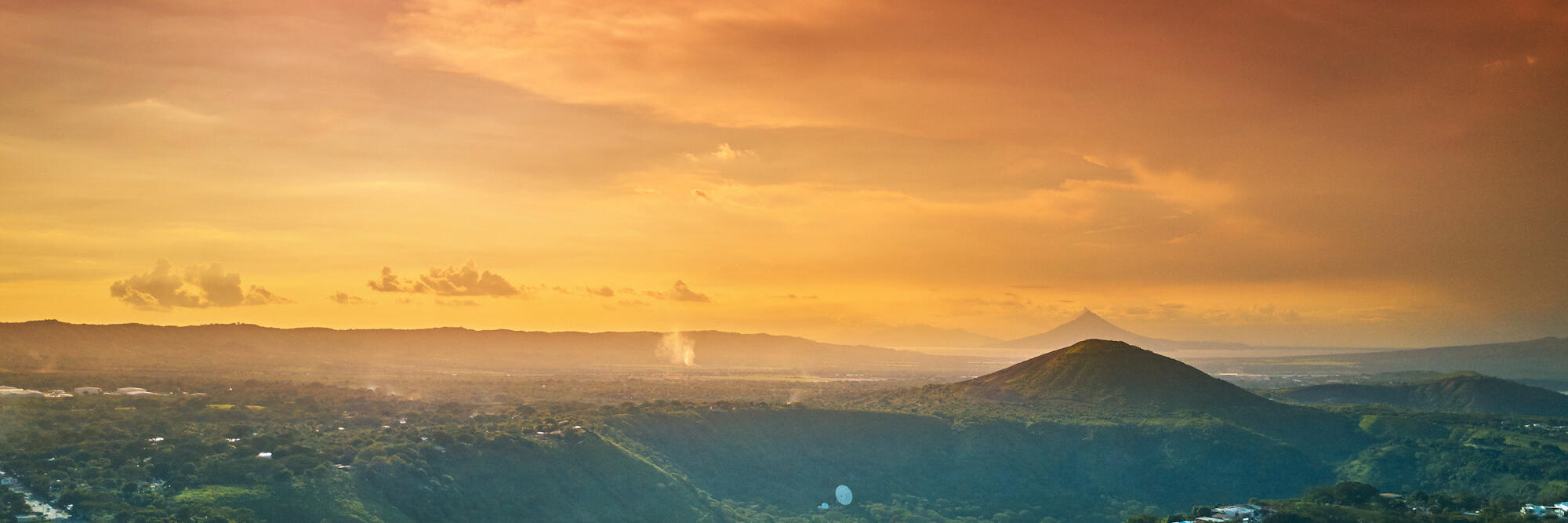
Expats moving to Nicaragua find tropical forests, volcanoes, freshwater lakes, and beaches on both the Pacific and Caribbean coasts. The country has a long and complex history, and there's plenty to see, from Spanish colonial cities to revolutionary landmarks. Many make the move for the low cost of living and the slower pace of life.
Living in Nicaragua as an expat
Living in Nicaragua as an expat takes some adjustment. The country can feel a long way from home at first, although you'll settle in faster once you learn some Spanish and can chat with locals. Spanish courses are widely available and of good quality, both in person and online.
Services and light manufacturing are now the biggest part of the economy. Most of the country's exports, though, are agricultural, especially coffee, beef, sugar, and gold. Expats tend to come to retire, start a small business, or teach English, and a growing number work remotely for clients abroad. Formal jobs for foreigners are scarce, and openings with NGOs and international organisations have thinned out, so tourism and hospitality are the most realistic ways to earn locally.
Although the expat community in Nicaragua is small, it's concentrated. Most settle in Granada, the beach town of San Juan del Sur, or León. Smaller communities have formed in cooler mountain towns like Matagalpa. Accommodation in the country is generally affordable, which is why many retire here. Detached houses are the norm, although you'll find furnished flats and rentals closer to the cities. Buying property is open to foreigners, but you should use a reputable local lawyer and check the title carefully, as land and ownership disputes are common.
Nicaragua's main modes of transport are buses and several forms of taxis. Interurban buses allow for travel between major destinations. The country has both a Pacific and a Caribbean coast, and boats are often the main way to get around on the Caribbean side, where roads are few. The main gateway is Augusto C. Sandino International Airport in Managua, and there's a second, smaller airport near the Pacific beaches for the San Juan del Sur and Rivas area. Private cars are handy, but many roads are rough or unpaved, and locals advise against driving at night.
Managua has a handful of modern private hospitals, a couple of which are rated among the better facilities in Central America. Some of their doctors are trained abroad and speak English. Most expats use private hospitals, although these are mostly in the larger cities. Public healthcare is free at the point of use for citizens and legal residents, and medicines and treatment cost far less than in North America or Europe. Even so, public healthcare is stretched and hard to access outside the cities, so most expats carry private health insurance.
Cost of living in Nicaragua
For retirees and remote workers, a low cost of living in Nicaragua is one of the country's biggest draws. Prices are well below what you'd pay in North America or Western Europe, although rent in the popular expat towns has crept up over the last few years.
Housing and food are especially cheap. Domestic help is inexpensive and easy to find, which frees up time for the country's many leisure activities. Popular pastimes like volcano boarding, horseback riding, boating, and fishing all cost little.
Families and children in Nicaragua
Families and children in Nicaragua often turn to private or international schools, since the public system is underfunded. Popular schools fill up, so it's wise to apply well ahead of your move.
There's plenty to fill a weekend, whether that's surfing on the Pacific, relaxing on a quiet Caribbean beach, taking in the lakes and colonial towns, or heading out to Ometepe. Families can go volcano boarding down Cerro Negro near León, or birdwatching in the Bosawás Biosphere Reserve up north.
Climate in Nicaragua
There's not much seasonal change to the climate in Nicaragua, which is warm all around the year. The real difference is between the dry season, roughly November to April, and the wet months that follow. It's not all sunshine, though. In the rainy season, heavy downpours can last for days, and hurricanes occasionally hit the Caribbean coast. The government runs a national disaster-preparedness agency (SINAPRED) that coordinates evacuations before major storms.
It won't take long to feel right at home. Nicaraguans have a reputation for being friendly and welcoming to foreigners, and there's no shortage of things to see and do. The country has its rough edges, but life here is relaxed and good value, which is why many expats stay.
Fast facts
Official name: Republic of Nicaragua
Population: Around 7 million
Capital city: Managua (also the largest city)
Other cities: León, Granada, and Masaya
Neighbouring countries: Nicaragua shares land borders with Honduras to the north and Costa Rica to the south. The Caribbean lies to the east and the Pacific Ocean to the west.
Geography: Nicaragua has a variety of climates and terrains. Its geography can be divided into three zones: the Pacific lowlands, the cooler central highlands, and the Caribbean lowlands.
Political system: Unitary presidential republic under a co-presidency since 2025
Major religions: Christianity, mainly Roman Catholic with a large Evangelical minority
Main language: Spanish is the official language. English and indigenous languages such as Miskito are spoken mainly on the Caribbean coast.
Money: The Nicaraguan Córdoba (NIO) is divided into 100 centavos. Most major shops and restaurants will accept credit cards. ATMs are readily available in most towns and cities, and US dollars are widely accepted alongside the local córdoba.
Tipping: 10 percent of the bill is the customary tip in restaurants, but it is not obligatory.
Time: GMT-6
Electricity: 120V, 60 Hz. Plugs here have two flat blades.
Internet domain: .ni
International dialling code: +505
Emergency contacts: 118 (police), 115 (fire), 128 (Red Cross/ambulance); 911 also works from mobile phones
Transport and driving: The main modes of public transport in Nicaragua are buses and taxis. Cars drive on the right-hand side.