
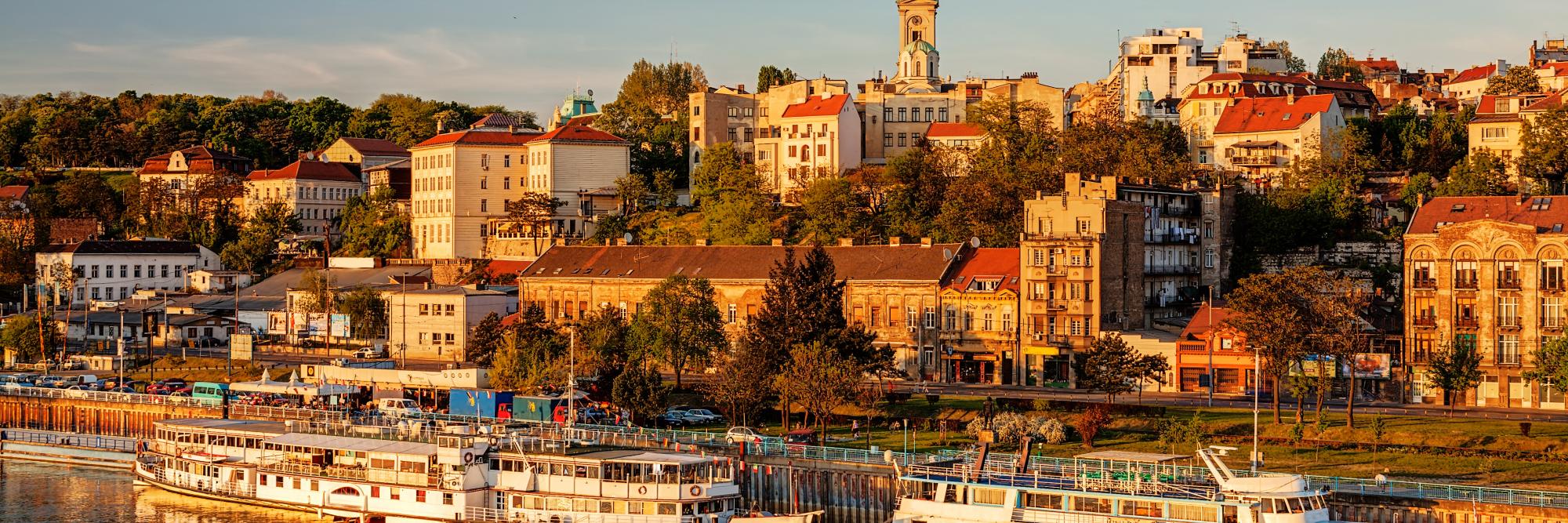
Although not the most conventional destination for expats, Serbia is one of Europe’s best-kept secrets. The country’s natural beauty is truly something to behold, from deep blue lakes and rivers to soaring mountains.
Many internationals move to Serbia to work as diplomats or in one of its thriving industries, but they often stay for the relaxed pace of life. While locals generally welcome foreigners, you should try to communicate in Serbian to build a bond with them.
Living in Serbia as an expat
Serbian is the country’s official language, and although you’ll get a long way in English as a second one, living in Serbia as an expat is far easier once you pick up some Serbian. You might find it helpful to hire an interpreter at work. It’s worth getting to grips with the Cyrillic alphabet too, since it makes everyday tasks far less of a puzzle.
Serbia’s unemployment rate is far lower than it was a decade ago, but competition for good jobs is still stiff, so it’s best to line up work before you move. Most of Serbia’s small expat community is based in the capital, Belgrade. They tend to work in diplomacy or for international organisations and NGOs. Other large sectors where you might find work are energy, automotive, machinery, mining, and agriculture. The IT industry is booming, and it’s now the most export-oriented sector in the Balkans. There’s strong demand for software developers and engineers, and while Belgrade is the main tech hub, Novi Sad and Niš aren’t far behind.
Accommodation in Serbia is affordable, and the standard of living is reasonably high. Housing in rural areas tends to be older and a bit more run-down than in big cities like Belgrade, and even the larger cities have their share of ageing buildings and patchy infrastructure. Foreign nationals can buy residential property here too, as long as there’s reciprocity. Your home country has to grant Serbian citizens the same right, and once that’s confirmed, it’s usually straightforward to rent a flat or house.
Buses run the length of the country, and Belgrade also has trams and trolleybuses. At the start of 2025, the capital scrapped its transport fares, so rides there are now free. BG Voz runs suburban trains out to the smaller towns and the areas around the capital. Roads in rural areas can be a bit rough, but driving in Serbia is reasonably safe, and the government continues to expand the motorway network. The Morava Corridor is one of the largest recent road projects, and it runs through central Serbia.
The healthcare in Serbia isn’t quite up to the standard you’d find in Western Europe or North America. While Serbian doctors are well trained and speak good English, there are limited medical supplies, and some hospitals may not have the necessary equipment to carry out more complex procedures.
Emergency treatment is free if you’re covered by the state health fund (RFZO), which is funded by employed residents’ contributions, or by a bilateral agreement between Serbia and your home country. Without that cover, you will have to pay out of pocket and reclaim the cost later.
In many cases, you might need to travel abroad for specialist care or turn to a private clinic. Pharmacies stock is generally decent in the cities, although some medicines can be harder to find.
Cost of living in Serbia
The cost of living in Serbia is comparatively low by European standards. Accommodation and transport are inexpensive, which makes it an attractive base for expat workers, particularly those who earn in foreign currencies. Food and dining out may be more expensive in certain areas, but the overall costs are manageable.
The most significant expenses for expats in Serbia are typically private healthcare and international schooling. Belgrade is still one of the more budget-friendly capitals in Europe. It’s a bit pricier than it used to be, but the city is far cheaper than most of Western Europe, so you can live comfortably here without spending a fortune.
Families and children in Serbia
Public education in Serbia tends to be underfunded, so a lot of expat families with children end up enrolling them in private or international schools. In Belgrade, there are several international schools that run American, British, German, and IB curricula. Places are limited, and waiting lists are long, so many parents send their children to boarding schools elsewhere in Europe instead.
There’s plenty of history to show the kids, from medieval monasteries to hilltop fortresses. You can also head out of the towns to hike through dramatic canyons and past unusual rock formations. Belgrade itself has lots to keep little ones busy, from museums to indoor play centres.
Climate in Serbia
Cold, dry winters and warm, humid summers up north are typical of the continental climate in Serbia. Further south it’s more Mediterranean, so summers are hot and dry and winters are milder and wetter. There’s heavy snow up in the mountains.
New arrivals can find Serbia’s patchy infrastructure frustrating, but give it a bit of time, and you’ll fall for this charming country off the beaten track. Warm locals, a fascinating history, striking scenery, and a low cost of living make Serbia well worth the effort for any seasoned expat.
Fast facts
Official name: Republic of Serbia
Population: Around 6.6 million
Capital city: Belgrade (also the largest city)
Other cities: Novi Sad, Niš, Kragujevac
Neighbouring countries: Serbia is bordered by Hungary to the north, Romania and Bulgaria to the east, North Macedonia to the south, Montenegro to the southwest, Bosnia and Herzegovina to the west and Croatia to the northwest.
Geography: Serbia’s southern half is mostly mountainous, while the north is largely fertile plains.
Political system: Unitary parliamentary constitutional republic
Major religions: Eastern Orthodox Christianity
Main language: Serbian is the official language. Both the Cyrillic and Latin alphabets are in everyday use.
Money: The country’s currency is the Serbian dinar (RSD). ATMs are readily available in large cities but may be harder to find in more rural areas. You should be able to open a Serbian bank account with relative ease.
Tipping: Tip 10 percent in a restaurant, or round up for smaller amounts.
Time: GMT+1 (GMT+2 from the last Sunday in March to the last Sunday in October)
Electricity: 230V, 50Hz. Two-pin, round-prong plugs are used.
Internet domain: .rs
International dialling code: +381
Emergency contacts: 192 (police), 193 (fire), 194 (ambulance)
Transport and driving: Cars drive on the right-hand side of the road. Belgrade is the country’s main public transport hub, and it made its whole network free to ride at the start of 2025.